
 Garden care
 Indoor plants
 Cemetery care
 Regular care
Pruning fruit trees: what to cut in autumn and what to leave until February
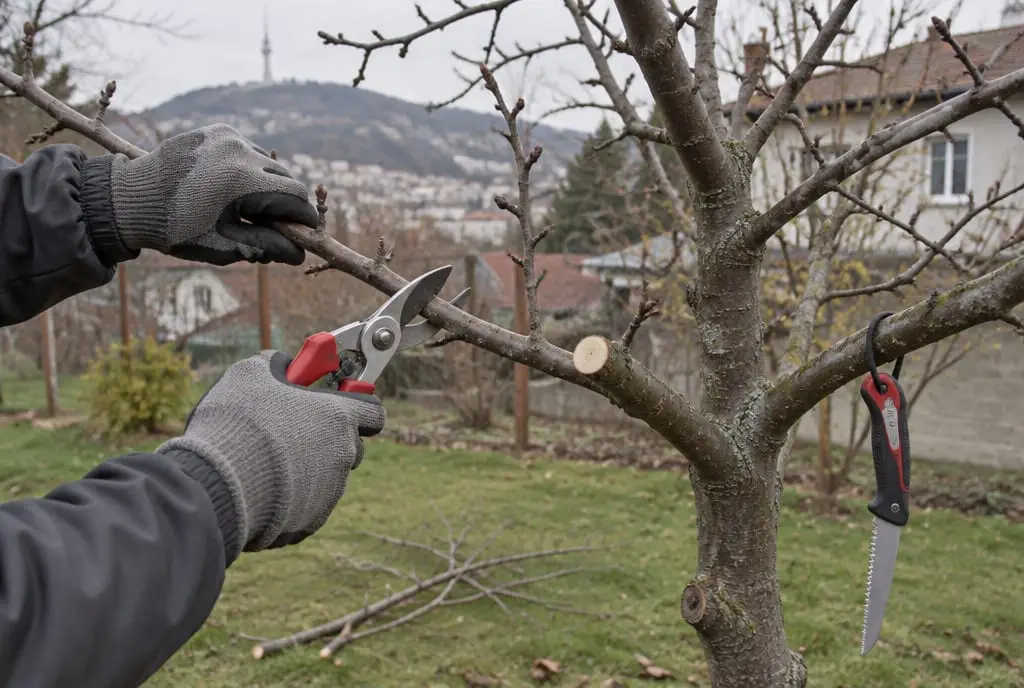
After leaf fall, cut only dead, broken and diseased branches from fruit trees. Leave the main pruning of apples and pears until February: by then the hard frosts are over and the buds have not yet opened.

- In autumn: tidying cuts only
- Which tree to prune when
- Which branches to remove
- How to cut properly
- A young tree: shaping
- An old, neglected tree
- Questions people ask
In autumn: tidying cuts only
A cut made in autumn can't heal before winter. Frost damages the bark around the wound, and in wet weather fungus gets in. So for now, cut only what the tree no longer needs anyway:
- Dead branches — no buds, brittle, with bark cracking or peeling off.
- Broken branches — from wind, snow or the weight of the crop.
- Diseased branches — with dark, sunken patches on the bark or a dried-out tip.
- Suckers — shoots coming up from the ground at the foot of the trunk.
Pick off any shrivelled, rotten fruit still hanging on the branches too. Brown rot spends the winter on it and infects the blossom in spring.
Which tree to prune when
A pruning calendar for Tbilisi
Apple, pear, quince
At the end of winter, before the buds open. This is the main pruning: you shape and thin the crown.
Peach, apricot, plum
As the buds swell or the first flowers open. You can see which branches have come through the winter.
Sweet and sour cherry
After the harvest, on a dry day. Cut in winter, they ooze gum and the tree falls ill.
Dead and broken branches
Whenever you notice them. Removing these never harms a tree.
In western Georgia everything starts two or three weeks earlier, in the mountains later. Don't prune in hard frost, below minus 8 degrees: the wood is brittle and the cut splits.
Which branches to remove
First take out three things: dead, diseased and broken wood. Then step back, look at the crown and cut:
- Branches that cross or rub against each other. Remove the weaker of the two.
- Branches growing inwards, towards the centre of the crown.
- Thick shoots shooting straight up. They bear almost no fruit and shade the crown.
- Very low branches drooping towards the ground.
Never remove more than a quarter of the crown in one year. A tree pruned too hard answers next year with a mass of upright shoots and less fruit.
How to cut properly
- Cut a branch at its base, just outside the slightly swollen ring where it joins the trunk or a thicker branch. Don't cut into the ring and don't leave a stub: the wound heals from the ring, while a stub rots.
- When shortening a branch, cut just above an outward-facing bud, 5 mm above it, at a slight angle.
- Take a heavy branch off in three cuts: first an undercut 20–30 cm from the trunk, then a cut from above a little further out, and finally the remaining stub at the ring. That way the falling branch doesn't tear the bark off the trunk.
- Cover cuts larger than 3 cm with a thin layer of pruning sealant. Small cuts heal on their own.
- After a diseased tree, wipe your secateurs and saw with alcohol so you don't carry the disease to the next tree.
 Get your secateurs and saw in shape first:Garden tool careGarden basics · 5 min
A young tree: shaping
In the first 3–4 years, pruning is shaping: you are building the tree's future framework.
- Give apples and pears one central leader with 3–4 strong side branches around it at different heights.
- Keep the centre of peaches and apricots open: 3–4 main branches in a bowl shape, so sun gets into the crown.
- Side branches should leave the trunk at a wide angle, 45–60 degrees. A narrow, sharp fork can't take the weight of a crop and splits.
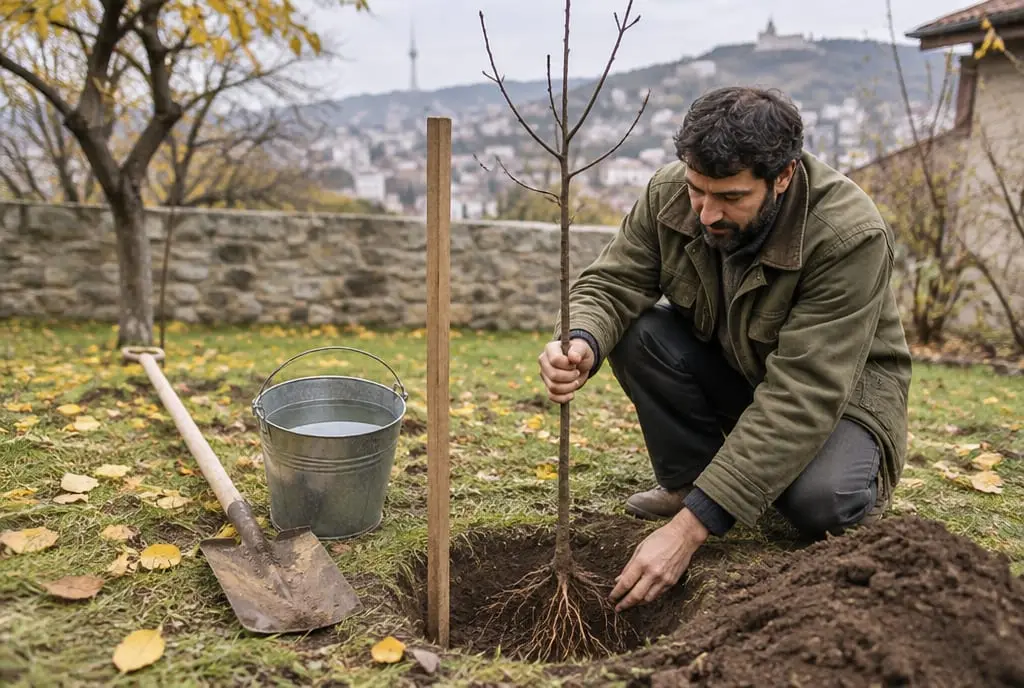 If you planted a sapling this autumn:Fruit trees in autumn: how to choose a sapling and plant itTrees & shrubs · 6 min
An old, neglected tree
If nobody has pruned a tree for years, don't try to put it right in one winter. Give it 2–3 years and remove a third of the problem branches each year: dead and diseased wood first, then branches growing into the crown and tangled together. Bring the height down gradually.
Don't work alone in a tall tree, on a ladder, with a saw. A heavy branch swings sideways as it falls. Leave that kind of job to a gardener.
Poll
Who prunes your fruit trees?
0 votes
Questions people ask
Can I prune fruit trees in November?
Only to tidy them: dead, broken and diseased branches. Leave shaping until the end of winter.
What happens if I never prune a tree?
The crown grows dense and the sun no longer gets inside. The fruit gets smaller and falls ill more often, and the crop comes in fits: plenty one year, little the next.
What do I do with the cut branches?
Chop healthy thin branches and use them in compost or as mulch. Put diseased ones out with the rubbish. Burning branches and leaves in the yard is fined by law.
Do I need pruning sealant?
Small cuts heal on their own. Cover cuts larger than 3 cm with a thin layer so that damp and fungus stay out. Don't put it on thickly.
Comments 0
Which tree or shrub do you have, and what worries you?
Comments appear at once. We delete rude ones and ads.






 Service approved!The money went to the gardener. Thank you.

 Profile under reviewOur team is reviewing your profile. You'll get a notification once it's approved.