
 Garden care
 Indoor plants
 Cemetery care
 Regular care
A thuja hedge: how to plant it and why it turns yellow
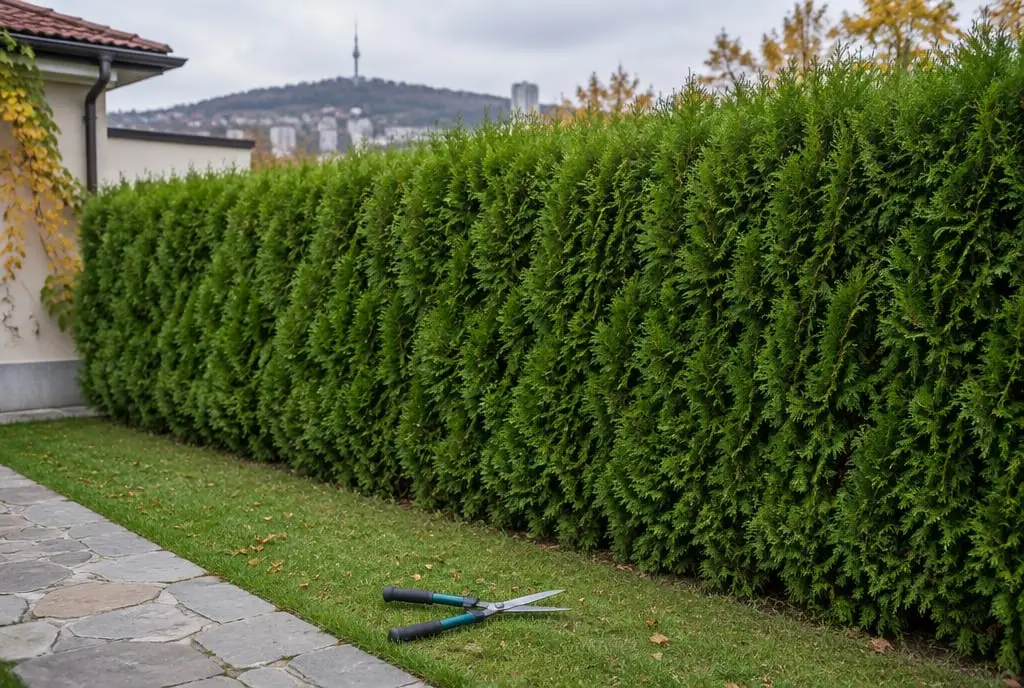
For a hedge, people most often plant Smaragd or Brabant, 60–80 cm apart, in autumn or early spring. Thuja most often turns yellow from lack of water — in the summer heat and in dry winter wind. So in the first two years, watering decides a great deal.

- Which thuja to choose
- When and how to plant
- Watering: the first two years
- Trimming: when and how much
- Why thuja turns yellow
- Feeding: in spring, and not too much
- Questions people ask
Which thuja to choose
At markets and nurseries you will most often find three kinds of thuja for a hedge.
Three thujas for a hedge
Smaragd
Slow-growing, 10–20 cm a year. It needs little trimming and stays green in winter.
Brabant
Puts on 30 cm a year or more and grows wider. You get a tall hedge sooner, but it needs trimming more often.
Oriental thuja
Copes with heat and dry spells better than the others. Its branches grow in upright fans, and it takes on a slight bronze tint in winter.
Few people plant box hedges these days: since the 2010s the box tree moth, an invasive species, has been destroying boxwood across Georgia. If you want a broadleaf hedge, cherry laurel and privet are better choices: both take trimming well.
When and how to plant
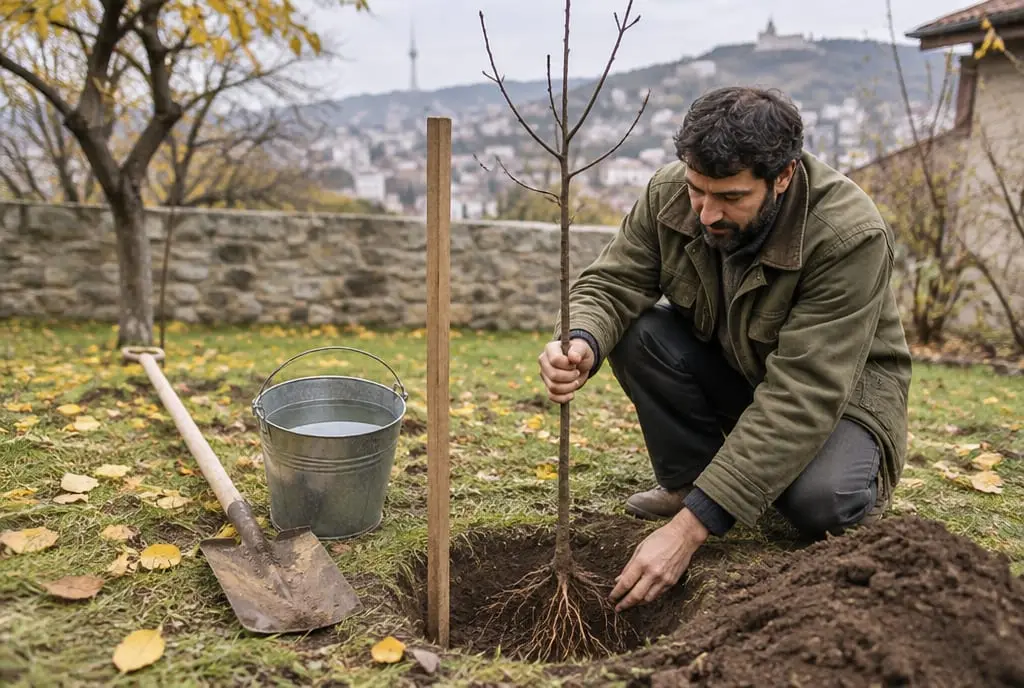
In Tbilisi, plant thuja in October–November, before the ground freezes, or in March–April. Container-grown plants can go in at other times too, just not in the summer heat.
- Dig a trench 50–60 cm wide and deep along the whole length of the hedge. Mix compost into the soil you dug out.
- Set the plants out in a line: Smaragd 50–70 cm apart, Brabant 70–100 cm.
- Keep the root collar level with the ground, as it was in the pot. Thuja planted too deep rots.
- Fill the trench in layers, firm the soil lightly and give each plant 10–20 litres of water.
- Spread 5–8 cm of mulch at the base, pine bark for example, a few centimetres away from the stems.
- For a thick hedge, plant two staggered rows.
Watering: the first two years
A young thuja's roots haven't gone deep yet, and summers in Tbilisi are hot and dry.
- In summer, water once or twice a week, 10–15 litres a plant, at the base rather than from above. In a heatwave, more often.
- Drip irrigation is the most practical for a hedge: the water goes in slowly and evenly.
- If the autumn is dry, water well before winter. Conifers lose water in winter too.
- In winter, on a mild, dry day, water again if it hasn't rained for a long time.
- Water must not stand at the base: thuja roots rot in standing water.
Trimming: when and how much
Thuja needs one or two trims a year. The first in late May or June, once the new growth has finished; the second in late August or early September. Don't trim in the July heat or in late autumn: fresh cuts get scorched by sun and frost.
- Cut green growth only. Old, bare wood doesn't sprout new shoots, and if you cut too deep, you leave a hole in the hedge.
- Keep the hedge slightly wider at the base than at the top. That way the sun reaches the lower branches and the base doesn't go bare.
- Once the hedge reaches the height you want, cut the tops: the thuja will spread outwards and grow denser.
- Trim on a cloudy day, so the sun doesn't scorch the fresh cuts.
Why thuja turns yellow
Five common reasons
Inside, in autumn
Old inner foliage turns yellow and drops every autumn. If the tips are green, the thuja is healthy.
Lack of water
In summer heat or a dry winter, the tips turn brown and the foliage becomes brittle.
Winter sun
Late in winter the sun warms the foliage while the roots draw water slowly from the cold soil. The patches appear on the south and west sides.
Dogs
If a dog urinates at the foot of the hedge, the lower branches turn yellow and die.
Fungus or pests
Individual branch tips turn brown, sometimes with tiny black dots on the foliage. Cut such a branch back to green.
If you can't work out the cause, take a close-up photo of the yellow patch and show it to Movla AI.
Poll
What is your hedge made of?
0 votes
Feeding: in spring, and not too much
In early spring, give thuja a fertiliser made for conifers, at the dose on the pack. From midsummer on, give no nitrogen fertiliser: soft new growth won't harden before winter and gets burnt.
 On winter care for trees and conifers:Caring for Trees in Winter: A Complete Guide to Protecting Your GardenTrees & shrubs · 8 min
Questions people ask
Should I plant thuja in November or wait for spring?
In Tbilisi you still can in November, before the ground freezes. Container plants settle in more easily. In the mountains and colder places, spring is better.
Will a yellowed thuja recover?
If the branch tips are alive and supple, yes: water it, mulch the base, and in spring new growth will cover the patch. A completely dead, brittle branch won't turn green again.
How long does a hedge take to grow?
Starting from plants about a metre tall, Brabant reaches two metres in 3–4 years, Smaragd in 6–8.
Will thuja grow in the shade?
It copes with half-shade, but in full shade it thins out and goes bare at the base. For a shady spot, cherry laurel is the better choice.
Comments 0
Which tree or shrub do you have, and what worries you?
Comments appear at once. We delete rude ones and ads.





 Service approved!The money went to the gardener. Thank you.
 Profile under reviewOur team is reviewing your profile. You'll get a notification once it's approved.