How do I know what kind of grass I have | Tips from “Movla”
How do I know what kind of grass I have | Tips from “Movla”
How do I know what kind of grass I have | Tips from “Movla”
Sali Beruchashvili
4-5 minutes
Proper selection and care of the lawn

Installing a lawn is a difficult but excellent investment for your yard. The main thing is to choose the right type of grass and ensure high-quality work. “Care” will help you with planning, choosing the right texture, and organizing the process effectively. We will tell you everything you need to create the perfect lawn.
Installing a lawn is a difficult but excellent investment for your yard. The main thing is to choose the right type of grass and ensure high-quality work. “Care” will help you with planning, choosing the right texture, and organizing the process effectively. We will tell you everything you need to create the perfect lawn.
The secret to a lawn lies not in its maintenance, but in choosing the right grass variety and properly preparing the soil in advance.
The secret to a lawn lies not in its maintenance, but in choosing the right grass variety and properly preparing the soil in advance.
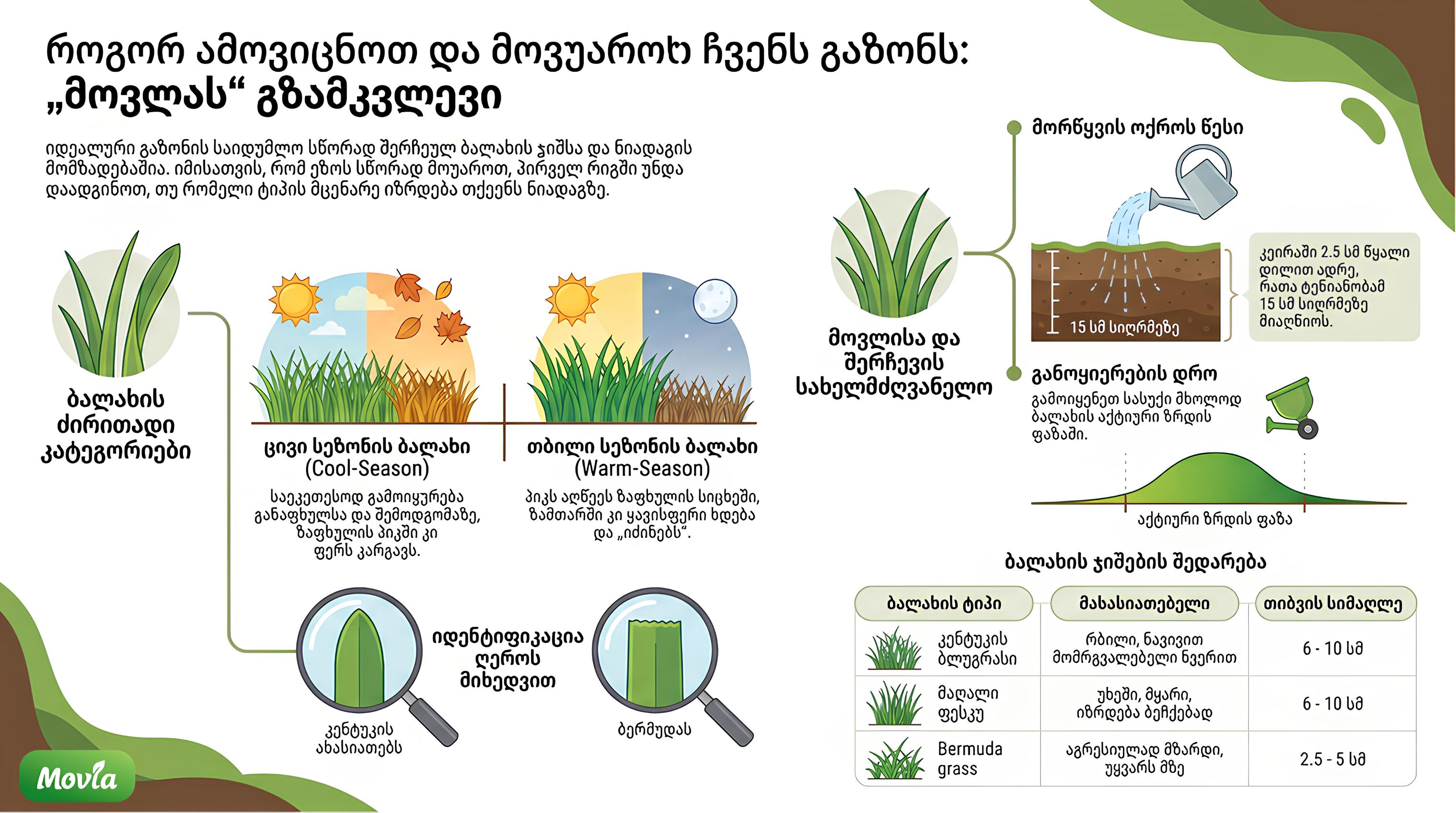
How do we identify what type of grass we have? The first step on the path to an ideal lawn is figuring out exactly what is growing in your yard. Different grass varieties need different amounts of sun, water, and care.
1. Observe the shape and texture of the grass blade. Grass types often differ by the tip of the blade and by touch:
Boat-shaped rounded tip: characteristic of "Kentucky bluegrass" — it feels soft to the touch.
Flat and coarse blade: characteristic of "Bermuda".
2. Growth habits and climate. In Georgia as well, grass is divided into two major groups:
Cool-season grass (Cool-Season): (e.g., fescue, Kentucky bluegrass) looks best in spring and fall.
Warm-season grass (Warm-Season): (e.g., Bermuda, zoysia) peaks in the summer heat and often turns brown in winter.
3. Visual signs by season If your lawn turns golden-brown in winter and turns green in summer, you have warm-season grass. If, on the contrary, the lawn turns green as early as early spring but loses color at the peak of summer, it is a cool-season variety.
Short guide to grass types:
Kentucky bluegrass: soft, with boat-shaped rounded tips (mowing: 6-10 cm).
Tall Fescue: coarse, stiff blades, grows in clumps (mowing: 6-10 cm).
Bermuda: aggressively growing, loves sun and heat (mowing: 2.5-5 cm).
St. Augustine: very broad and blunt blades (mowing: 9-10 cm).
Grass Type
Characteristic
Recommended Mowing Height
Kentucky bluegrass
Soft, with boat-shaped rounded tips.
6 - 10 cm
Tall Fescue (high fescue)
Coarse, stiff blades, grows in clumps.
6 - 10 cm
Bermuda
Aggressively growing, loves sun and heat.
2.5 - 5 cm
St. Augustine
Very broad and blunt blades.
9 - 10 cm
How do we identify what type of grass we have? The first step on the path to an ideal lawn is figuring out exactly what is growing in your yard. Different grass varieties need different amounts of sun, water, and care.
1. Observe the shape and texture of the grass blade. Grass types often differ by the tip of the blade and by touch:
Boat-shaped rounded tip: characteristic of "Kentucky bluegrass" — it feels soft to the touch.
Flat and coarse blade: characteristic of "Bermuda".
2. Growth habits and climate. In Georgia as well, grass is divided into two major groups:
Cool-season grass (Cool-Season): (e.g., fescue, Kentucky bluegrass) looks best in spring and fall.
Warm-season grass (Warm-Season): (e.g., Bermuda, zoysia) peaks in the summer heat and often turns brown in winter.
3. Visual signs by season If your lawn turns golden-brown in winter and turns green in summer, you have warm-season grass. If, on the contrary, the lawn turns green as early as early spring but loses color at the peak of summer, it is a cool-season variety.
Short guide to grass types:
Kentucky bluegrass: soft, with boat-shaped rounded tips (mowing: 6-10 cm).
Tall Fescue: coarse, stiff blades, grows in clumps (mowing: 6-10 cm).
Bermuda: aggressively growing, loves sun and heat (mowing: 2.5-5 cm).
St. Augustine: very broad and blunt blades (mowing: 9-10 cm).
Grass Type
Characteristic
Recommended Mowing Height
Kentucky bluegrass
Soft, with boat-shaped rounded tips.
6 - 10 cm
Tall Fescue (high fescue)
Coarse, stiff blades, grows in clumps.
6 - 10 cm
Bermuda
Aggressively growing, loves sun and heat.
2.5 - 5 cm
St. Augustine
Very broad and blunt blades.
9 - 10 cm
Conclusion
Summary
What should we do after identification?
Watering: About 2.5 cm of water per week. It is best to water early in the morning.
Fertilizing: Use fertilizer only during the active growth phase.
Reseeding: Always use seed of the same variety to avoid patchiness.
Need help identifying grass? The “Movla” team is ready to assess your yard, create a custom plan, and connect you with a professional.
👉 Start caring for your lawn professionally: https://app.movla.ge/
Blog
Read other articles
Blog
Read other articles
Blog
Read other articles



Caring for us is easy
Download the "Movla" app and find the specialist you need, or fill out an application and become a gardener yourself!
simple
reliable
safe
Caring for us is easy
Download the "Movla" app and find the specialist you need, or fill out an application and become a gardener yourself!
Caring for us is easy
Download the "Movla" app and find the specialist you need, or fill out an application and become a gardener yourself!